
Plutonomics is the science of individual wealth. While the discipline includes economics, business, and finance, plutonomics also encompasses and integrates subject matter that lies beyond the scope of these prior fields.
Unlike finance, which reduces wealth to an objective, abstract, static quantity such as net worth, plutonomics recognizes wealth as a subjective, contextual, dynamic interaction between the individual and his or her environment, evaluating wealth as a likelihood that such interaction will accord with the individual’s preferences.
| Net Worth | Wealth (Plutonomic) |
|---|---|
| Abstract | Contextual |
| Static | Dynamic |
| Objective | Subjective |
| A Quantity | A Likelihood |
| Transferable Goods/Assets | Transferable + Non-Transferable Wealth Factors |
Unlike economics, which studies how societies allocate scarce, transferable goods and services, plutonomics encompasses not only such allocation but also an individual’s non-transferable capacities⸺his or her biological and psychological traits, state of health, personal relationships and social status, environmental conditions, and abilities, as well as constraints imposed by the laws of nature.
| Economics | Plutonomics |
|---|---|
| Depends Upon Markets/Transactions | Fully Viable With or Without Markets |
| Goods and Services | All Manner of Wealth Phenomena |
| Aggregate-Based | Individual-Based |
Fundamental Dynamic of Wealth
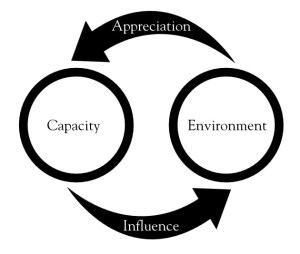
In plutonomics, wealth is recognized as a dynamic interaction between an individual and his or her environment⸺that person’s plutonomy. For analytical purposes, this interaction is viewed in terms of four basic factors: the individual’s capacity, the individual’s environment, the effects of the environment on the individual (appreciation), and the effects of the individual on his or her environment (influence). Taken together, these factors comprise the fundamental dynamic of wealth.
The foundational theory of plutonomics was created between 1992 and 1995 by author S. E. Harrison. Harrison revived and pluralized an archaic term, plutonomic, to clearly distinguish the new discipline from tributary fields.
This site provides supporting materials, including a glossary for terms as used in plutonomics, and updates regarding an upcoming book project, entitled Applied Plutonomics.


You must be logged in to post a comment.